Reliable OGEA-103 Test Price & OGEA-103 Reliable Dumps Book
Wiki Article
BONUS!!! Download part of TestSimulate OGEA-103 dumps for free: https://drive.google.com/open?id=1qnpN51c4-jMTiFL9NsdlMEBMJevWD5mo
The OGEA-103 study materials of our company is the study tool which best suits these people who long to copyright and get the related certification. So we want to tell you that it is high time for you to buy and use our OGEA-103 Study Materials carefully. Now we are glad to introduce the study materials from our company to you in detail in order to let you understanding our study products.
To pass the OGEA-103 exam is not an easy task. It is a challenging exam. However, proper planning and preparation with OGEA-103 exam questions can enable you to pass the OGEA-103 exam easily. As far as the The Open Group OGEA-103 Practice Test are concerned, these OGEA-103 Practice Test questions are designed and verified by The Open Group OGEA-103 exam trainers. So you rest assured that with OGEA-103 exam real questions you can pass TOGAF Enterprise Architecture Combined Part 1 and Part 2 Exam OGEA-103 exam easily.
>> Reliable OGEA-103 Test Price <<
Go With The Open Group OGEA-103 Exam Dumps [2026] For Instant Success
The language of our OGEA-103 study materials is simple. The learners may come from many social positions and their abilities to master our OGEA-103 study materials are varied. Based on this consideration we apply the most simple and easy-to-be-understood language to help the learners no matter he or she is the students or the in-service staff, the novice or the experienced employee which have worked for many years. OGEA-103 Study Material use the simple language to explain the answers and detailed knowledge points and the concise words to show the complicated information about the OGEA-103 study material.
The TOGAF Enterprise Architecture Combined Part 1 and Part 2 Certification Exam is designed for individuals who want to demonstrate their knowledge and expertise in enterprise architecture. It is ideal for enterprise architects, solution architects, IT architects, and anyone who is involved in the design, planning, and implementation of enterprise architecture. OGEA-103 Exam is also suitable for professionals who are responsible for managing or overseeing enterprise architecture initiatives.
The Open Group TOGAF Enterprise Architecture Combined Part 1 and Part 2 Exam Sample Questions (Q65-Q70):
NEW QUESTION # 65
Please read this scenario prior to answering the question
You are employed as an Enterprise Architect working at a vehicle manufacturing company. The company specializes in buses and coaches. You are part of an Enterprise Architecture (EA) team that has responsibilities across multiple divisions of the company. EA provides the company with a comprehensive framework to develop and manage their manufacturing infrastructure, processes for component production, and design and testing systems.
The company has a corporate strategy that focuses on switching to electric power for its vehicles. It has invested heavily in a new standardized design, production efforts, and major components to use across all its product range. The company has multiple manufacturing plants in North America, Europe, and in Asia.
Customer demand has caused a backlog of orders because many customers want to have more environmentally friendly public transportation. There are not enough electronic components available, which is making it hard to produce products and meet customer demand. To address this issue, the company has started making the battery packs themselves and has hired new suppliers.
The EA team is working on a project to improve the process and systems to design, produce, and test the battery pack. As part of putting the new battery pack into production, changes to the assembly processes need to be made. A trial has been completed at a single location. The Chief Engineer, sponsor of the project, and the Architecture Board have approved the plan to roll out these changes to all plants.
Preliminary Architecture Contracts are being developed to detail the work needed to put in place the new processes for each location. The EA team leader has called a meeting to discuss the contracts. It is emphasized that the Architecture Contract will serve as the key connection between architecture and implementation organizations.
The company mixes internal teams with a few third-party contractors at the locations.
The Chief Engineer is worried that the implementation and deployment will not be consistent and of satisfactory quality.
The company has an established EA practice. It uses the TOGAF standard as the foundation for its work including the internal EA framework. Additionally, the company uses various management frameworks such as business planning, project management, and operations management.
Refer to the scenario
The EA team leader asks you how you would address the Chief Engineer's concern.
Based on the TOGAF standard, which of the following is the best answer?
- A. The contracts must be used to manage the architecture governance processes across the locations. Monitoring tools must be put in place to assess the performance of each completed battery pack at each location. If a deviation from the contract is needed, the Architecture Board should allow the Architecture Contract to be modified for the location. In such cases they should issue a new Request for Architecture Work to implement a modification to the Architecture Definition.
- B. The contracts must specify goals, measures, acceptance terms, and risks.
Third-party contracts must be legally enforceable. It is advisable to establish a schedule of compliance reviews at key points in the implementation process.
The Architecture Board must review all deviations from the Architecture Contract and consider whether to grant a dispensation to allow the process to be customized for local needs. Ensure that all dispensations are time-bound rather than indefinite. - C. The contracts must be checked to ensure they have flexibility. For changes undertaken by internal teams, a memorandum of understanding between the Architecture Board and the implementation organization is needed. If a contract is issued to a contractor, it must be a fully enforceable legal contract. If a deviation from the Architecture Contract is found, the Architecture Board must grant a dispensation to allow the implementation organization to customize the process to meet their local needs.
- D. The contracts must be checked to ensure they can be used to direct and control the implementation teams. For contracts issued to third-party contractors, they must be enforceable legal contracts. For internal development teams, a memorandum of understanding with the Architecture Board is needed. The Architecture Board must review all deviations from the Architecture Contract and decide whether to grant a dispensation to allow the implementation organization to customize the process to meet their local needs.
Answer: B
Explanation:
The Chief Engineer is concerned that implementation across multiple plants and mixed teams (internal + contractors) may be inconsistent and of poor quality.
The question asks: How should Architecture Contracts be used to address this concern according to the TOGAF standard?
TOGAF states that an Architecture Contract must:
Define obligations of both architecture and implementation organizations Specify metrics, measures, acceptance criteria, and success factors Identify risks and mitigation Support Architecture Governance through compliance reviews Apply to BOTH internal teams and external suppliers (external contracts must be legally enforceable) Option C is the only one that correctly reflects these TOGAF requirements.
✔ Why Option C is correct
1. Architecture Contracts must specify goals, measures, acceptance terms, and risks TOGAF explicitly states that Architecture Contracts should include:
Statement of Architecture Work
Performance metrics and measures
Acceptance criteria
Risks and issues
Compliance and conformance requirements
Option C includes all of these.
2. Third-party contracts must be legally enforceable
True - TOGAF states that when external suppliers are involved, Architecture Contracts often take the form of legally binding contracts.
Option C:
"Third-party contracts must be legally enforceable."
Correct.
3. Compliance reviews must be scheduled
TOGAF's Architecture Governance Framework prescribes scheduled Architecture Compliance Reviews to ensure that implementation conforms to the Architecture Contract.
Option C:
"establish a schedule of compliance reviews at key points"
Correct - this directly addresses the Chief Engineer's concern about consistency and quality.
4. Deviations must be reviewed by the Architecture Board and any dispensations should be time-bound TOGAF allows dispensations but requires:
Formal review
Approval by the Architecture Board
Time-bound accommodations rather than permanent exceptions
Option C includes exactly this guidance.
NEW QUESTION # 66
Consider the diagram showing a classification model for Architecture Landscapes.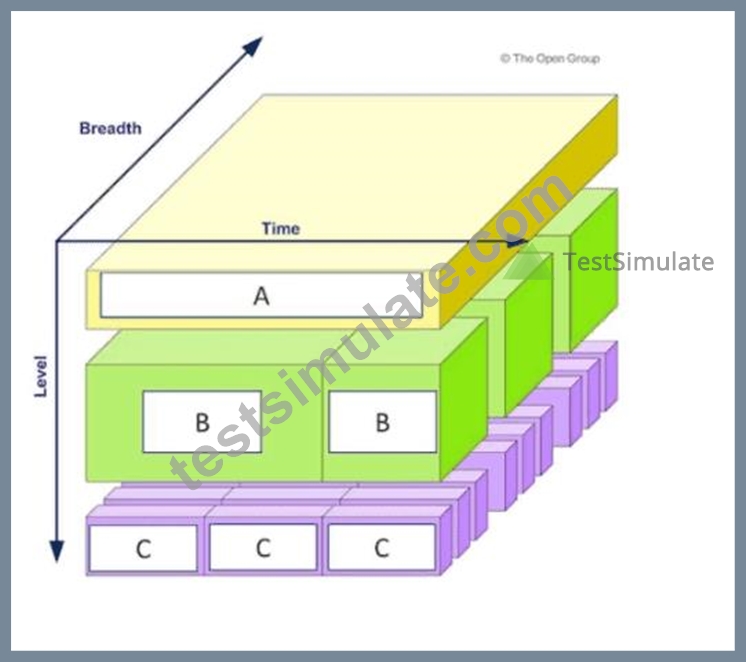
What are the items labelled A, B and C?
- A. A-Enterprise Strategic Architecture. B-Segment Architecture. C-Capability Architecture
- B. A-Corporate Capability. B-Portfolio Capability. C-Project Capability
- C. A-Architecture Vision. B-Business Architecture. C-Architecture Development
- D. A-Strategy Architecture. B-Tactic Architecture, C-Operational Architecture
Answer: A
NEW QUESTION # 67
Consider the following statement:
Separate projects may operate their own ADM cycles concurrently, with relationships between the different projects What does it illustrate?
- A. Iteration
- B. Requirements management
- C. Implementation governance
- D. Enterprise Architecture
Answer: A
Explanation:
The statement illustrates iteration and the ADM. Iteration is the technique of repeating a process or a phase with the aim of improving or refining the outcome. Iteration allows for feedback loops and adaptations at any point in the architecture development and transition process. Separate projects may operate their own ADM cycles concurrently, with relationships between the different projects, to address different aspects or levels of the architecture in an iterative manner. Reference: The TOGAF Standard | The Open Group Website, Section
3.1 Introduction to the ADM.
NEW QUESTION # 68
Which of the following is a responsibility of an Architecture Board?
- A. Conducting assessments of the maturity level of architecture discipline within the organization
- B. Establishing targets for re-use of components
- C. Allocating resources for architecture projects
- D. Creating the Statement of Architecture Work
Answer: A
Explanation:
Explanation
The Architecture Board is a governance body that oversees and supports the implementation of architectures within an organization. One of its responsibilities is to conduct assessments of the maturity level of architecture discipline within the organization using frameworks such as CMMI or ACMM. This helps to identify areas for improvement and monitor progress towards achieving higher levels of maturity. References:
https://pubs.opengroup.org/architecture/togaf9-doc/arch/chap44.html
NEW QUESTION # 69
Which of the following describes how the Enterprise Continuum is used when developing an enterprise architecture?
- A. To classify architecture and solution assets
- B. To coordinate with the other management frameworks in use
- C. To identify and understand business requirements
- D. To describe how an architecture addresses stakeholder concerns
Answer: A
Explanation:
The Enterprise Continuum consists of two complementary concepts: the Architecture Continuum and the Solutions Continuum1. The Architecture Continuum provides a consistent way to describe and understand the generic and reusable architecture building blocks, such as models, patterns, and standards, that can be applied and tailored to specific situations2. The Solutions Continuum provides a consistent way to describe and understand the specific and implemented solution building blocks, such as products, services, and components, that realize the architecture building blocks3. The Enterprise Continuum enables the reuse and integration of architecture and solution assets across different levels of abstraction, scope, and detail, ranging from foundation architectures to organization-specific architectures1.
The Enterprise Continuum is used when developing an enterprise architecture to support the following activities1:
*Selecting relevant architecture and solution assets from the Architecture Repository or other sources, based on the business drivers, goals, and requirements
*Adapting and customizing the architecture and solution assets to suit the specific needs and context of the enterprise
*Defining and developing the target architecture and the architecture roadmap, based on the gaps and opportunities identified between the baseline and the target states
*Defining and developing the implementation and migration plan, based on the architecture roadmap and the solution building blocks
*Governing and managing the architecture and solution assets throughout the architecture lifecycle, ensuring their quality, consistency, and compliance References: 1: The TOGAF Standard, Version 9.2 - Enterprise Continuum 2: The TOGAF Standard, Version
9.2 - Architecture Continuum 3: The TOGAF Standard, Version 9.2 - Solutions Continuum
NEW QUESTION # 70
......
Yes, as a lot of our loyal customers who have passed the OGEA-103 exam and got the certification said that more than the OGEA-103 certification, they felt they had been benifited more for they had obtained the knowledge and apply it in the daily work, which can help them finish all tasks efficiently. Then they do not need to work overtime. It is necessary to learn our OGEA-103 Guide materials if you want to own a bright career development.
OGEA-103 Reliable Dumps Book: https://www.testsimulate.com/OGEA-103-study-materials.html
- Download OGEA-103 Fee ???? OGEA-103 Test Assessment ???? Test OGEA-103 Lab Questions ???? Open ⮆ www.practicevce.com ⮄ enter 【 OGEA-103 】 and obtain a free download ????Valid OGEA-103 Dumps Demo
- Quiz 2026 The Open Group Updated Reliable OGEA-103 Test Price ⚠ Easily obtain free download of ⇛ OGEA-103 ⇚ by searching on 【 www.pdfvce.com 】 ????Exam OGEA-103 Preparation
- Test OGEA-103 Dumps ???? Valid OGEA-103 Dumps Demo ???? OGEA-103 Exam Sample Questions ???? Open 【 www.prepawaypdf.com 】 enter ✔ OGEA-103 ️✔️ and obtain a free download ????Test OGEA-103 Lab Questions
- 100% Pass Quiz OGEA-103 - Reliable Reliable TOGAF Enterprise Architecture Combined Part 1 and Part 2 Exam Test Price ???? Download 《 OGEA-103 》 for free by simply searching on ▷ www.pdfvce.com ◁ ????OGEA-103 Dumps Questions
- High Pass-Rate Reliable OGEA-103 Test Price - Leading Provider in Qualification Exams - Fast Download OGEA-103 Reliable Dumps Book ???? Search for ▶ OGEA-103 ◀ and download it for free on ⮆ www.practicevce.com ⮄ website ????New OGEA-103 Mock Test
- Another way to prepare for the OGEA-103 Exam ▛ Open ➽ www.pdfvce.com ???? and search for 【 OGEA-103 】 to download exam materials for free ????OGEA-103 Dumps Questions
- OGEA-103 Latest Exam Test ???? OGEA-103 Test Assessment ⛴ New OGEA-103 Mock Test ⛅ Enter 《 www.troytecdumps.com 》 and search for { OGEA-103 } to download for free ????OGEA-103 Latest Exam Test
- 100% Pass Quiz The Open Group - OGEA-103 - TOGAF Enterprise Architecture Combined Part 1 and Part 2 Exam Useful Reliable Test Price ???? Open ▷ www.pdfvce.com ◁ and search for [ OGEA-103 ] to download exam materials for free ????Test OGEA-103 Lab Questions
- Download OGEA-103 Fee ???? OGEA-103 Dumps Questions ???? Reliable OGEA-103 Exam Prep ???? Search for ✔ OGEA-103 ️✔️ and download it for free immediately on ➤ www.pdfdumps.com ⮘ ????Download OGEA-103 Fee
- OGEA-103 Exam Sample Questions ???? OGEA-103 PDF Download ???? OGEA-103 Test Assessment ???? Search for ☀ OGEA-103 ️☀️ and easily obtain a free download on [ www.pdfvce.com ] ????Download OGEA-103 Fee
- OGEA-103 Valid Test Dumps ???? OGEA-103 PDF Download ⛹ Valid OGEA-103 Practice Materials ???? Search for ➥ OGEA-103 ???? and download it for free on ▷ www.dumpsmaterials.com ◁ website ????Test OGEA-103 Dumps
- onelifesocial.com, www.stes.tyc.edu.tw, www.stes.tyc.edu.tw, jadaprtx272415.59bloggers.com, www.stes.tyc.edu.tw, margiezvgl750147.blogsuperapp.com, rafaeldenk601280.life3dblog.com, directory-king.com, jesseulnh151481.blogsvirals.com, cyberbookmarking.com, Disposable vapes
What's more, part of that TestSimulate OGEA-103 dumps now are free: https://drive.google.com/open?id=1qnpN51c4-jMTiFL9NsdlMEBMJevWD5mo
Report this wiki page